

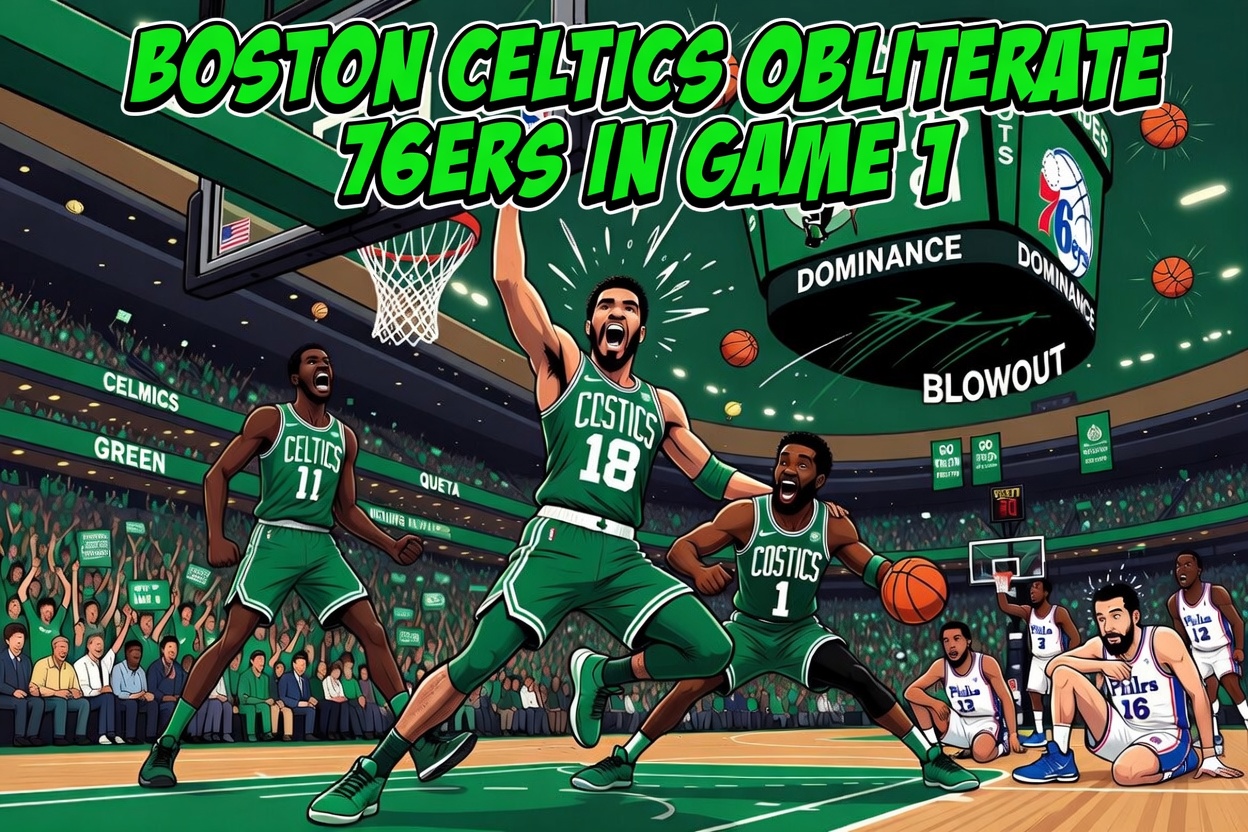
On April 21, 2026, the Boston Celtics experienced a humbling setback in their quest for another deep playoff run, falling 111-97 to the Philadelphia 76ers in Game 2 of the Eastern Conference First Round. While the series now stands at an even 1-1, the way in which the Celtics faltered raised questions not only about their immediate strategy but also about the psychological fortitude of a team that has long carried championship expectations. This was not a simple off-night; it was a performance that revealed cracks in Boston’s armor and simultaneously highlighted the ascendance of a young Sixers core led by V.J. Edgecombe and Tyrese Maxey.
The Celtics’ faithful, who packed TD Garden with the usual sea of green, expected a continuation of the Game 1 dominance that had briefly reassured Boston that their playoff journey would start on stable ground. Instead, the crowd was introduced to the harsh reality that the postseason rarely follows the script of regular-season triumphs and predictive analytics. In the span of 48 minutes, a playoff series that seemed to be tilting in Boston’s favor suddenly became a tense, evenly matched contest where every possession began to feel existential.
Analyzing the Boston Collapse
Boston’s offensive rhythm in Game 2 could best be described as a carefully choreographed dance that suddenly turned into an awkward shuffle. Jaylen Brown was heroic in his pursuit of offensive production, scoring 36 points and almost single-handedly keeping the Celtics in striking distance. Yet, this individual brilliance masked a troubling lack of cohesive ball movement. Jayson Tatum, despite snagging 14 rebounds and dishing out 9 assists, finished with a modest 19 points, struggling to find his shooting rhythm against a Philadelphia defense that seemed newly energized and surprisingly versatile.
Much of Boston’s downfall can be attributed to their inability to adapt to the Sixers’ defensive adjustments. Philadelphia made a clear choice to pressure Tatum early, forcing the ball out of his hands and daring Boston’s role players to beat them. The result? A series of hesitant possessions, missed open looks, and an overall sense that the Celtics’ supporting cast was not ready for the elevated intensity of playoff basketball.
V.J. Edgecombe: The Unexpected Star
V.J. Edgecombe’s 30-point, 10-rebound masterpiece was not just a statistical anomaly; it was a statement. On a team already featuring the dynamic Tyrese Maxey and the ever-important presence of Joel Embiid, Edgecombe stepped into the spotlight with a confidence that belied his playoff inexperience. He moved with a fluidity that frustrated Boston’s perimeter defenders, consistently attacking closeouts and finishing through contact at the rim. For Celtics fans, watching Edgecombe carve up their defense felt like discovering a subplot in a novel that suddenly becomes more captivating than the main narrative.
His performance also speaks to a broader theme in modern basketball: the rise of versatile wings who can create their own shot while contributing across the stat sheet. In many ways, Edgecombe’s emergence in Game 2 mirrored the early playoff explosions of players like Jimmy Butler or Jayson Tatum in previous seasons—a reminder that postseason basketball is a crucible in which new stars are forged.
Tyrese Maxey’s Steady Leadership
While Edgecombe stole the headlines, Tyrese Maxey was the engine that powered Philadelphia’s offensive system. His 29 points and 9 assists were a masterclass in controlled aggression. Unlike in previous seasons where the Sixers’ guard play occasionally faltered under pressure, Maxey displayed a poise that was infectious for the younger players on the roster. He continually probed the Celtics’ defense, exploiting mismatches, and ensuring that Boston was never able to mount a sustained comeback.
Maxey’s impact went beyond scoring efficiency. His ability to dictate tempo kept Boston off-balance, preventing the Celtics from generating the fast-break opportunities that usually energize their offense. By the fourth quarter, the Celtics’ defenders looked less like the switchable, swarming unit of Game 1 and more like a team resigned to chasing shadows.
The Psychological Battle of Playoff Adjustments
NBA playoff series are as much about mental fortitude as they are about talent and tactics. The Celtics entered Game 2 with the comfort of home-court advantage and the confidence of a team that had largely controlled the previous meeting. Losing in such a definitive manner has a dual effect: it erodes that confidence while simultaneously emboldening the opponent. The Sixers, now armed with the knowledge that they can win on the road, will return to Philadelphia with the momentum that every underdog craves.
This loss also reopens the perennial conversation about Boston’s mental toughness. For all their regular-season accolades, the Celtics have struggled at times to close out series or maintain intensity in the face of adversity. Game 2 was a reminder that the margin for error in the playoffs is razor-thin, and any lapse in focus or execution can be fatal against a hungry opponent.
What Boston Must Change for Game 3
As the series shifts to Philadelphia for Game 3 on April 24, the Celtics face a critical juncture. They must address several glaring issues if they hope to regain control of the series:
- Offensive Cohesion: Ball movement cannot stagnate around isolation sets for Tatum and Brown. Secondary scorers must be involved early to avoid predictability.
- Transition Defense: The Sixers thrived whenever Boston failed to communicate in defensive transition. Improved floor balance is non-negotiable.
- Psychological Resilience: The Celtics need to respond with urgency, not panic, in an environment that will be hostile and opportunistic.
Boston’s coaching staff will also have to decide whether to shorten the rotation or to continue trusting the bench. In Game 2, the supporting cast provided little in the way of secondary scoring or defensive resistance, leaving the starters to shoulder a disproportionate load. Playoff history suggests that even the most talented teams falter when they fail to adapt quickly.
The Broader Implications for the Series
Historically, the winner of Game 3 in a 1-1 series often sets the tone for the remainder of the matchup. If Boston can steal back momentum in Philadelphia, the Game 2 loss may be remembered as a temporary stumble. But if the Sixers protect home court and take a 2-1 lead, the Celtics will find themselves in a precarious position, forced to confront both external scrutiny and internal doubt.
For the Sixers, this game represents more than just a chance to advance in the playoffs; it is an opportunity to redefine the narrative of a franchise that has been living in the shadows of its own unfulfilled potential. A victory in this series would signal that their youth movement, led by Maxey and Edgecombe, is not a future promise but a present reality.
Conclusion: A Series Poised for Drama
Game 2 was a reminder that the NBA playoffs rarely adhere to a predictable storyline. The Celtics, armed with star power and experience, suddenly find themselves in a dogfight against a team willing to rise to the occasion. The Sixers, buoyed by Edgecombe’s breakout and Maxey’s steadying hand, now carry both confidence and momentum into Philadelphia. For fans and analysts alike, the series has transformed into a compelling chess match—one in which every move, adjustment, and mental lapse carries amplified consequences. As the teams prepare for Game 3, the only certainty is that the drama is just beginning.
Leave a Reply
You must be logged in to post a comment.