

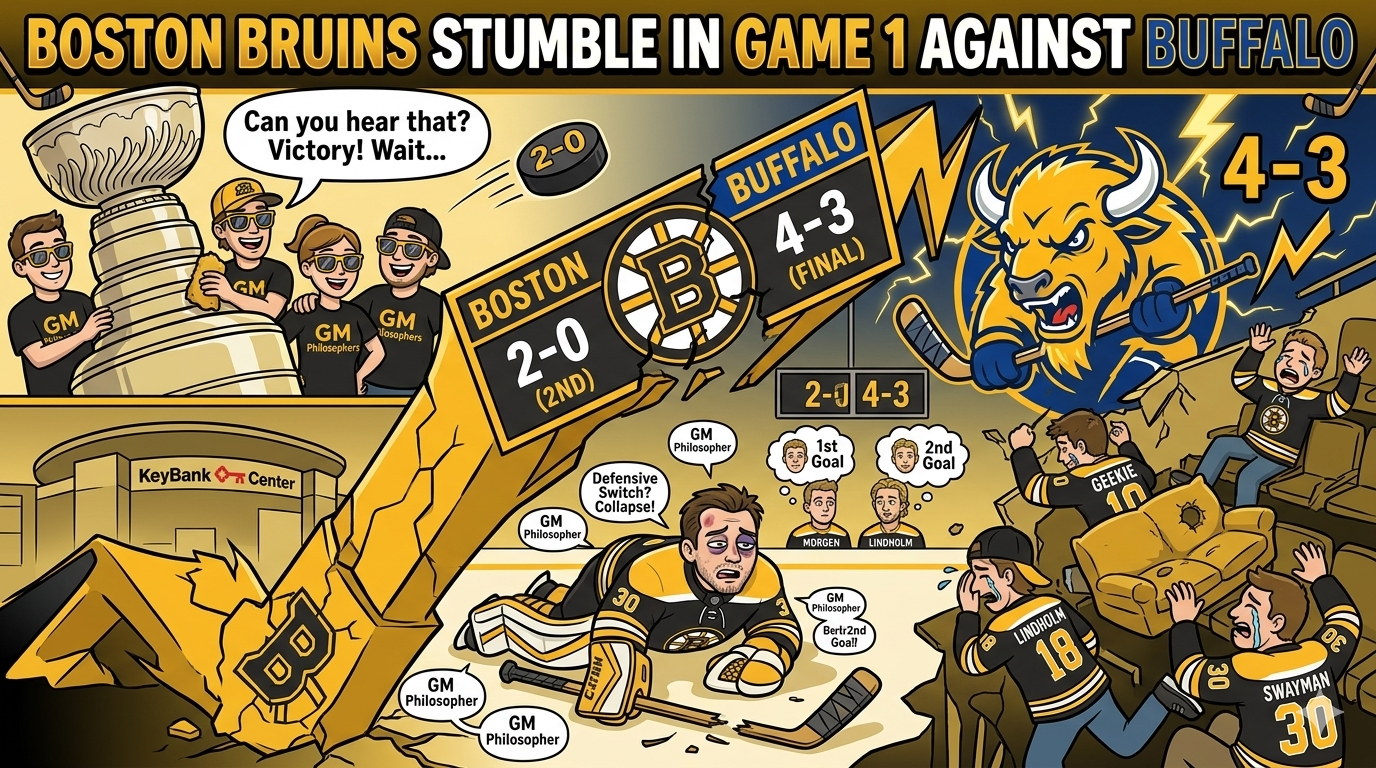
Playoff hockey has a way of combining unrelenting tension with a circus of emotions, and the Boston Bruins proved that on April 19, 2026, in Buffalo. For two and a half glorious periods, Bruins fans could almost hear the Stanley Cup being dusted off somewhere in the distance. Then, in a fashion that only postseason hockey can deliver, the Buffalo Sabres decided to remind everyone that no lead is safe, no heart rate is stable, and no couch cushion survives the third period of a playoff collapse unscathed. The Bruins, leading 2-0 on goals from Morgan Geekie and Elias Lindholm, eventually fell 4-3 in Game 1 of the Eastern Conference First Round at KeyBank Center. Jeremy Swayman’s 34 saves were heroic, but the result left Boston fans pacing kitchens and debating every defensive switch like amateur GM philosophers.
Let’s be honest: if hockey were a purely logical sport, the Bruins would have walked away with a tidy, clinical 2-0 win. But hockey is a game of chaos. It’s Newton’s third law in skates: for every beautiful goal, there is an equal and opposite defensive meltdown. And in the third period, the Bruins discovered that gravity applies to leads the same way it applies to unattended pizza slices hovering over carpet. Three unanswered goals by Buffalo flipped the script faster than a Boston sports radio caller flipping opinions after a bad inning at Fenway. David Pastrnak’s late power-play goal added drama, but not salvation, leaving the final score 4-3 Sabres and Bruins fans muttering, “Well, of course…” into their Dunkin’ cups.
The Anatomy of a Collapse
To understand how a 2-0 lead dissolved like ice chips in a warm Gatorade bottle, we must dissect the Bruins’ third-period unraveling. The first two periods were a masterclass in structured, disciplined hockey. Swayman looked like he had vacuum-sealed the net. The Sabres’ shooters, though feisty, seemed more like background characters in Boston’s poised defensive narrative. Then came the third period—a Shakespearean tragedy acted out in skates and shoulder pads, with the Bruins playing the role of Hamlet juggling defensive miscues and unlucky bounces.
Buffalo’s first goal cracked the veneer of Boston’s composure. Suddenly, the neutral zone felt like a carnival midway. Odd-man rushes sprouted like spring weeds. By the time the tying goal went in, you could see the subtle panic in the Bruins’ passing choices—hesitation on clears, choppy breakouts, and defensemen pinching at the blue line like they were auditioning for a blooper reel. Playoff hockey punishes hesitation more than bad karaoke punishes eardrums.
Jeremy Swayman and the Burden of Brilliance
It’s unfair, in some cosmic way, that a goaltender can play brilliantly for 58 out of 60 minutes and still end up as the losing netminder. Jeremy Swayman’s 34 saves were textbook examples of reflex, positioning, and raw stubbornness. He stopped breakaways, deflected screened shots, and even appeared to invent a new yoga pose during one sprawling second-period save. And yet, the box score will remember him simply as the guy who gave up four goals. Such is the lonely math of playoff goaltending: you’re either the unbreakable hero or the unlucky mortal, depending on whether your team remembers how to clear the crease.
Swayman’s postgame interviews have evolved into quiet studies in New England stoicism. He rarely blames anyone, shrugs off bad luck, and projects the vibe of someone who might go home and meditate in front of a lobster tank at Legal Sea Foods. But make no mistake: the Bruins will need him at his acrobatic best in Game 2 if they hope to even the series in Buffalo.
Offense: Half Fireworks, Half Flickering Candle
Boston’s offense in Game 1 was a study in contrasts. The opening goals were beautiful in their simplicity—Morgan Geekie finding the net with opportunistic instinct, and Elias Lindholm finishing a sequence that felt like a jazz improvisation on ice. They were goals that made fans believe in the rhythm of destiny. Then came the dry spell. The Bruins generated chances, but Buffalo’s goaltender seemed to grow larger with each save, like a video game boss you can’t quite beat. By the time Pastrnak scored a late power-play goal, it felt less like a resurgence and more like a noble soliloquy in a doomed act.
One cannot simply win playoff games on highlight-reel moments alone. Sustained forechecking, second-chance rebounds, and opportunistic rushes will be the bread and butter for Boston in this series. If the Bruins want to avoid making Buffalo’s goalie look like a future Hall of Famer, they’ll need to turn those pretty zone entries into ugly, greasy goalmouth scrambles.
The Psychology of Momentum
Momentum in hockey is an elusive, almost mystical force. Analysts talk about it as if it’s a currency, a measurable energy that shifts from bench to bench. In reality, it’s more like caffeine jitters: invisible, powerful, and capable of making rational teams behave unpredictably. The Bruins entered the third period with confidence bordering on swagger. Then, in the span of a single Buffalo goal, that confidence wavered. Fans could practically feel the tension radiating through the TV screen as passes became tentative and clearing attempts resembled half-hearted broom sweeps in a haunted attic.
Teams that master momentum management often go deep in the playoffs. The ability to reset after a bad bounce, a questionable penalty, or a sudden deficit separates contenders from cautionary tales. Game 1 was a cautionary tale. For Boston to rebound, the locker room must rediscover equilibrium—a mental state somewhere between Zen calm and caffeinated aggression.
Why Game 2 Matters More Than It Should
It’s a seven-game series, but there’s a reason hockey historians obsess over Game 2 outcomes. Losing the first two games on the road doesn’t end a series, but it turns the climb into a Mount Everest expedition with a backpack full of anvils. The Bruins, to their credit, have bounced back from opening losses before. Yet the emotional weight of playoff narratives is heavy: a 1-1 series split feels like hope; a 0-2 deficit feels like a Greek tragedy in black and gold.
Game 2 will test Boston’s resilience, coaching adjustments, and their willingness to embrace the glorious absurdity of playoff hockey. Will Pastrnak light the lamp again? Will Swayman channel his inner fortress? And will the Bruins find a way to play sixty full minutes without inviting chaos to dinner?
Conclusion: Embrace the Madness
Playoff hockey is not for the faint of heart, nor for those who prefer tidy narratives. Game 1 was a rollercoaster, a Greek epic, and a slapstick comedy all in one. The Bruins stumbled, but the series is young. Fans might gnash teeth and doom-scroll, but deep down, they know this is the glorious torment they signed up for. For Boston to advance, they must transform Game 1’s heartbreak into fuel, laughter into focus, and chaos into opportunity. Until then, keep the heart medication handy and the optimism cautiously refrigerated.
| As of April 20, 2026, the Boston Bruins have no games scheduled in the next seven days. Their first-round playoff series against the Buffalo Sabres begins on April 19, 2026, with Game 1 at KeyBank Center in Buffalo. Subsequent games are scheduled for April 21, 23, and 26, with potential additional games on April 28, May 1, and May 3, if necessary. Broadcast details for these games are available on NESN and 98.5 The Sports Hub. For the most current information, please refer to the official Boston Bruins website or trusted sports news outlets. |
Leave a Reply
You must be logged in to post a comment.