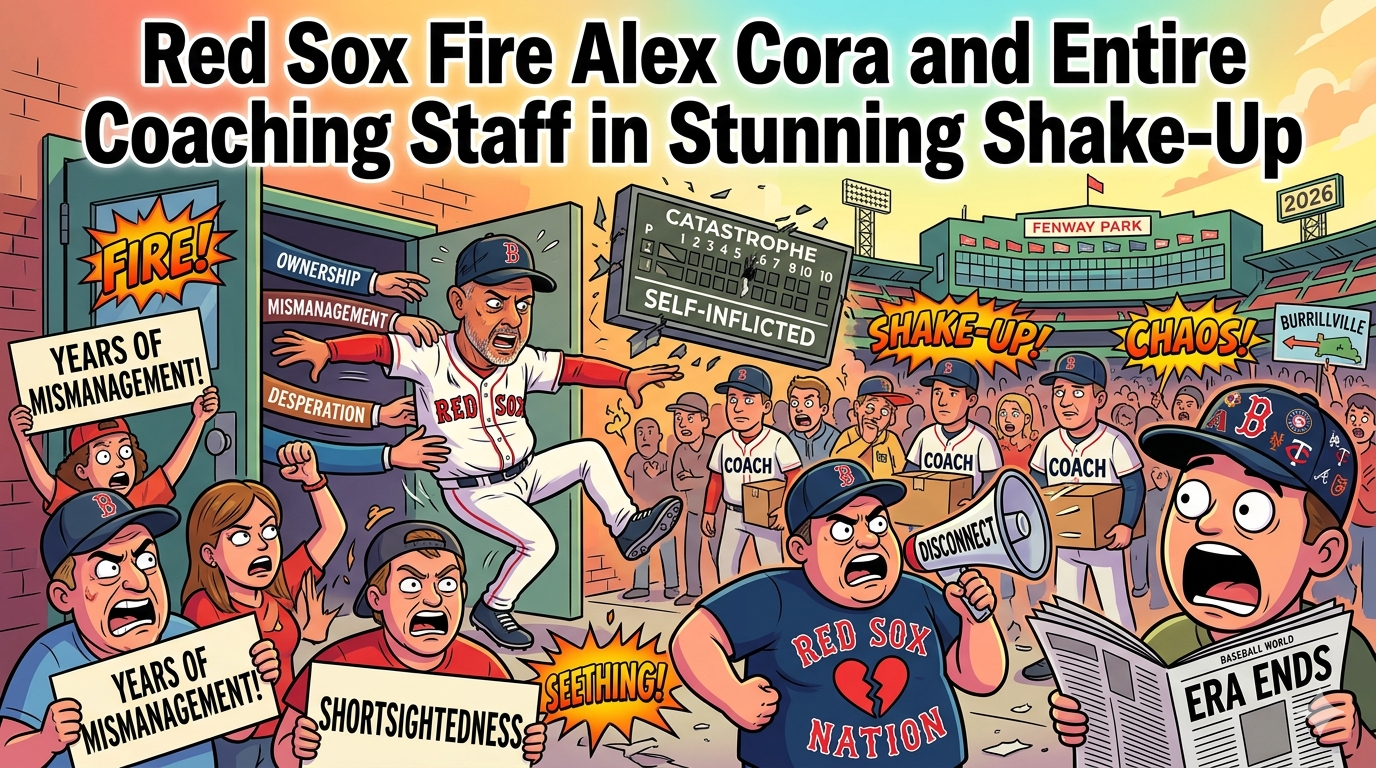
The Boston Red Sox have done it again—another self-inflicted catastrophe that leaves fans seething and the baseball world in disbelief. In an abrupt, almost theatrical act of desperation, the organization has fired manager Alex Cora and his entire coaching staff. This decision does not just mark the end of an era; it represents the culmination of years of mismanagement, shortsightedness, and a profound disconnect between ownership and the heartbeat of Red Sox Nation.
The Breaking Point
Even in a franchise as storied and historically volatile as the Red Sox, the firing of Alex Cora stings with a unique bitterness. Cora, beloved by many fans and respected by his players, was more than just a manager; he was a symbol of resilience after the organization’s previous missteps. His leadership helped bring a World Series title back to Boston in 2018, but in the years since, the front office’s relentless, almost reckless turnover of talent has repeatedly undermined the team’s chemistry and competitiveness.
The trigger for this drastic move appears to be a combination of underperformance, clubhouse fractures, and a growing sense that ownership has lost patience with incremental fixes. But the anger swirling through Red Sox Nation is not just about results; it’s about the optics and timing. This feels like scapegoating at its most brazen. Instead of addressing systemic failures in the front office, the team has chosen to sacrifice Cora and his staff in a public spectacle that reeks of panic.
The Disconnect Between Ownership and Fans
It is impossible to overstate the growing chasm between the Red Sox ownership group and its loyal fan base. For years, fans have been told to trust the process, to endure rebuilds and questionable trades in the name of sustainability. Yet the pattern has become painfully familiar: cost-cutting masquerading as long-term planning, star players shipped out for unproven prospects, and a carousel of managers expected to clean up the mess left behind by executives. This firing is the latest and loudest example of that dysfunction.
The Red Sox are not some small-market experiment trying to scrape together a competitive roster on a shoestring budget. They are one of the most valuable franchises in sports, with resources that should allow them to contend annually. Fans are right to ask why, then, the team’s competitive cycles are increasingly boom-and-bust, with leadership seemingly more concerned about luxury tax thresholds than parades down Boylston Street.
The Fallout in the Clubhouse
Sources close to the team report that the mood in the clubhouse is one of shock and disillusionment. Players who viewed Cora as a stabilizing force now face a void of leadership. While it is true that the team has stumbled this season in almost every conceivable way—from inconsistent pitching to a lineup that cannot seem to deliver in clutch situations—pinning the blame solely on the coaching staff is a gross oversimplification. Baseball is a game of long arcs and subtle adjustments, and organizational culture matters far more than any single in-game decision.
By removing Cora and his staff, the front office has effectively thrown a grenade into the middle of the season. Interim leadership will now be tasked with steadying a team that feels betrayed, while ownership attempts to spin this as an act of accountability. It is difficult to see how either mission succeeds in the short term.
A Legacy in Question
For Alex Cora, the dismissal raises questions about his legacy in Boston. He will always be the manager who guided the 2018 team to a historically dominant championship, but his tenure is now bookended by controversy and unceremonious exits. The harsh truth is that winning in Boston has never been enough to secure long-term job security—especially under an ownership group that prizes perception as much as performance.
Yet the legacy question cuts both ways. The Red Sox as an institution are now saddled with the perception of instability and opportunism. Each new managerial hire becomes harder to justify when the pattern of abrupt firings continues. Who, in their right mind, would want to step into this maelstrom knowing that success is fleeting and blame is eternal?
The Fans’ Boiling Point
Red Sox fans have endured a rollercoaster decade. From the ecstasy of 2018 to the frustration of underperforming seasons, they have remained loyal, packing Fenway Park and investing their hearts in a team that seems increasingly indifferent to their devotion. This firing may very well represent the breaking point for many. Social media is already ablaze with anger, with calls for ownership to sell the team or for front office executives to be held accountable.
In Boston, baseball is not just a pastime—it is an identity. When that identity is repeatedly disrespected by shortsighted decisions and tone-deaf messaging, the anger becomes generational. Parents who once passed down their Sox fandom with pride are now confronting the possibility that the organization is eroding the very tradition they hoped to preserve.
Where Does the Team Go From Here?
The immediate future for the Red Sox is murky at best. Interim leadership will attempt to salvage what is left of the season, but without a cohesive vision, the team risks spiraling further into chaos. Potential managerial candidates may be wary of stepping into a situation that seems engineered to produce scapegoats rather than stability.
Ownership will undoubtedly attempt to spin the narrative in the coming days, emphasizing a commitment to winning and a desire to reset the culture. But words are cheap, and actions speak louder. Until the front office demonstrates a willingness to invest in sustained success—both in player development and in maintaining a consistent managerial presence—fans will remain skeptical.
Conclusion: A Betrayal of Trust
The firing of Alex Cora and his staff is more than a managerial shake-up; it is a betrayal of trust. It signals that the Red Sox organization is willing to sacrifice stability and loyalty in the name of optics. For fans who have endured the highs and lows of this franchise, the message is clear: ownership’s patience is short, its priorities skewed, and its understanding of the fan base alarmingly shallow.
In the end, this decision may haunt the Red Sox far longer than any losing streak. For a franchise that prides itself on history, tradition, and connection to its city, the firing of Alex Cora will stand as a cautionary tale: winning hearts is harder than winning games, and losing both can be catastrophic.
Leave a Reply
You must be logged in to post a comment.