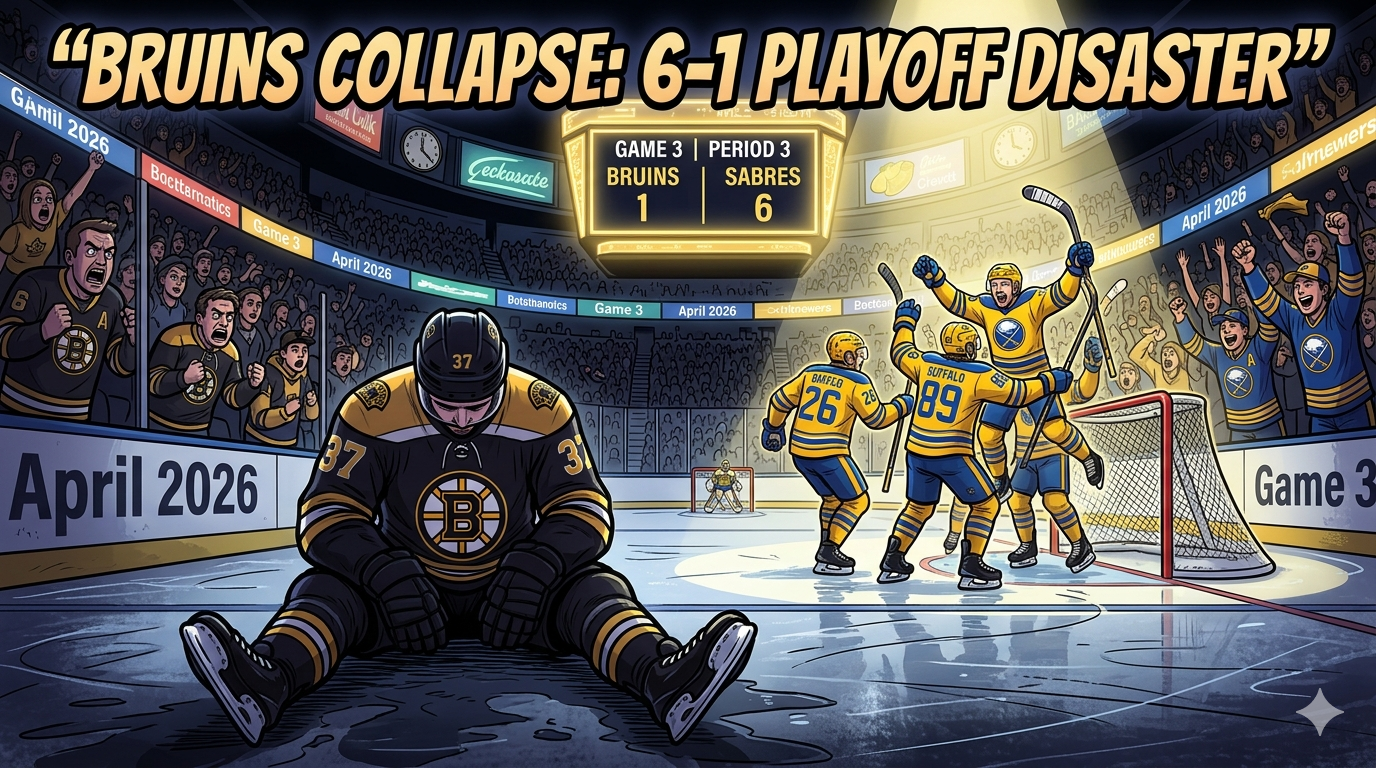
There are bad playoff losses, and then there are losses that stick to a franchise like a stain that refuses to come out. The Boston Bruins’ 6–1 defeat at the hands of the Buffalo Sabres wasn’t just another mark in the loss column—it was a full-scale embarrassment, a breakdown in every phase of the game that exposed weaknesses Bruins fans had feared but hoped would remain buried deep beneath regular-season success.
And somehow, it was even worse because it happened at home.
Inside TD Garden, in front of a crowd expecting playoff intensity and Bruins dominance, Boston delivered one of its most lifeless performances in recent memory. For a team built on grit, structure, and postseason pedigree, this performance felt like a betrayal of identity. The Bruins didn’t just lose—they unraveled.
And in the unforgiving spotlight of the National Hockey League playoffs, that kind of collapse doesn’t just cost you a game—it can shift the entire trajectory of a series.
A Nightmare Start in Front of the Home Crowd
From the opening puck drop, something felt off. The Bruins looked slow, hesitant, and disconnected—an unsettling sight in a building that typically fuels their energy.
Meanwhile, Buffalo came out flying.
Within minutes, the Sabres struck first, silencing the TD Garden crowd. A defensive miscommunication left a Buffalo forward wide open in the slot, and the puck found the back of the net before Boston could even settle into the game.
That early goal didn’t just put the Bruins behind—it drained the building.
Instead of feeding off the crowd, the Bruins seemed to shrink under the pressure, and the Sabres seized full control.
Defensive Breakdowns on Home Ice
The Bruins’ defensive structure—usually airtight, especially at home—completely fell apart.
Players were out of position. Coverage assignments were missed. Simple clears turned into turnovers. And every mistake was magnified by the fact that it was happening in their own building, right in front of their fans.
Buffalo didn’t hesitate to capitalize.
Odd-man rushes became routine. Rebounds sat untouched in dangerous areas. Screens in front of the net went uncontested. The Sabres turned TD Garden into their own highlight reel.
By the end of the second period, the Bruins weren’t just trailing—they were being dominated.
The Goaltending Struggles Under the Spotlight
A six-goal night is always going to raise questions about goaltending, especially in a playoff game at home.
But the reality is more complicated.
Boston’s goaltender was put in an impossible position. Defensive breakdowns led to high-quality scoring chances—breakaways, cross-ice passes, and wide-open shots from prime areas. No goalie thrives under that kind of pressure.
Still, playoff hockey demands timely saves, and Boston didn’t get enough of them.
When the Bruins needed a momentum-shifting stop to wake up the crowd and swing the game, it never came.
Special Teams Collapse
If the five-on-five play was bad, the special teams performance made things even worse.
The penalty kill was exposed repeatedly. Buffalo moved the puck with precision, creating open lanes and converting chances that should have been contested.
On the other side, the Bruins’ power play was completely ineffective.
Zone entries were sloppy. Setup was slow. Shot selection was predictable. The crowd grew increasingly restless as each failed opportunity passed.
In the playoffs, special teams are often the difference.
In this game, they were the dagger.
A Lack of Fight at TD Garden
Perhaps the most frustrating part for Bruins fans was the lack of pushback.
TD Garden is supposed to be one of the most intimidating arenas in hockey—a place where the Bruins feed off the energy and wear opponents down.
Instead, it felt quiet.
Boston didn’t bring the physical edge they’re known for. Hits weren’t finished. Board battles were lost. Net-front presence was minimal.
The Sabres dictated the pace from start to finish, and the Bruins never responded.
For a home playoff game, that’s inexcusable.
Offensive No-Show
Scoring just one goal in a playoff game is bad enough—but the Bruins didn’t even generate consistent pressure.
Shots came from the outside. There was little traffic in front of the net. Rebound opportunities were rare because no one was in position to capitalize.
The offense lacked urgency, creativity, and cohesion.
As the deficit grew, frustration took over. Passes missed. Plays broke down. The Bruins looked like a team pressing instead of executing.
And in front of their home fans, it only made the loss more painful.
Coaching Questions Intensify
Losses like this always bring coaching decisions into focus.
Why weren’t adjustments made sooner? Why did the same breakdowns continue shift after shift? Why didn’t the team respond emotionally or strategically?
Playoff hockey is about adaptability.
In this game, Boston looked stuck.
The Psychological Damage of a Home Blowout
Losing is one thing. Getting blown out at home is another.
The psychological impact of a 6–1 loss in your own building can linger. Confidence takes a hit. Doubt creeps in. The pressure to respond increases dramatically.
Now the Bruins must regroup—not just physically, but mentally.
Because the next game won’t just be about execution.
It will be about pride.
Buffalo Takes Control
Give credit where it’s due—the Sabres executed brilliantly.
They were faster, sharper, and more composed. They took advantage of every mistake and never let Boston settle into the game.
Winning on the road in the playoffs is never easy.
Dominating like this? That’s a statement.
What This Means Moving Forward
A 6–1 loss at home sends shockwaves.
For the Bruins, it’s a wake-up call. The margin for error in the playoffs is razor-thin, and performances like this simply cannot happen.
For Buffalo, it’s a confidence boost.
Momentum has shifted—and now Boston must take it back.
The Path Forward
If the Bruins want to recover, the blueprint is clear:
- Reestablish defensive structure
- Bring back physical intensity
- Create high-danger scoring chances
- Fix special teams immediately
- Reset mentally and emotionally
Because if they don’t, this game won’t just be remembered as an embarrassment.
It will be remembered as the turning point.
Final Thoughts
The Boston Bruins didn’t just lose to the Buffalo Sabres.
They were outplayed, outworked, and outclassed—on their own ice.
And that’s what makes this 6–1 loss so damaging.
TD Garden is supposed to be a fortress.
In this game, it felt like anything but.
Leave a Reply
You must be logged in to post a comment.