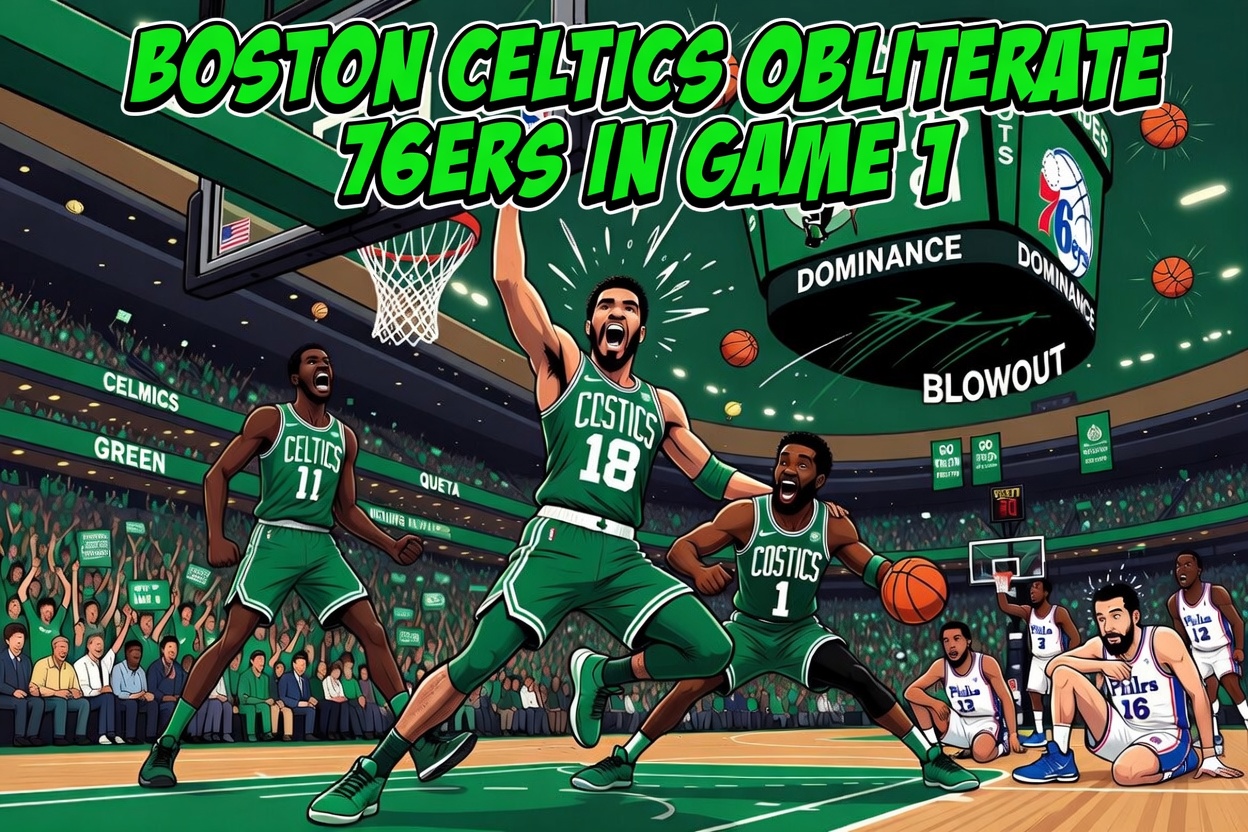
On April 30, 2026, the Boston Celtics marched into the Wells Fargo Center hoping to march out with a ticket to the Eastern Conference Finals. Instead, they left with a 106-93 loss, a suddenly even series, and about ten thousand reminders that playoff basketball rarely follows the script. The Philadelphia 76ers, powered by Tyrese Maxey’s relentless 30-point performance, forced a Game 7 that will now be played under the bright, anxiety-fueled lights of TD Garden. For Celtics fans, this was not the ending they ordered, and for 76ers fans, it was the perfect blend of hope and schadenfreude.
Jayson Tatum, Boston’s face of the franchise and occasional magician, contributed 17 points and 11 rebounds before exiting with left calf stiffness that sent a ripple of unease through New England. Head coach Joe Mazzulla, with the calm demeanor of a man trying to avoid spontaneous combustion, reassured the media that Tatum is expected to play in Game 7. Of course, he also said that after halftime adjustments in Game 6 would solve things, and then Tyrese Maxey promptly turned that plan into confetti. But let’s take him on his word for now.
The Anatomy of a Playoff Gut Punch
Game 6 was the kind of contest that exposes every insecurity a team has. The Celtics entered with a 3-2 series lead, dreams of rest, and visions of banner 18. Instead, they found themselves pressed into a defensive vice by a 76ers squad that smelled blood in the water. The Celtics’ offense sputtered, resembling a car that had been filled with the wrong type of gas—technically operational, but in constant danger of exploding or stalling.
Meanwhile, Tyrese Maxey was everywhere. When he wasn’t scoring with acrobatic drives or burying pull-up jumpers, he was injecting energy into a Philadelphia crowd that lives for tormenting Boston. Joel Embiid, while not at his most explosive, occupied defenders like a gravitational force, freeing his young teammate to go supernova. With each Maxey bucket, the Wells Fargo Center grew louder, and you could practically see Celtics fans at home negotiating with the basketball gods.
Boston’s offensive execution wavered under the spotlight. Tatum’s early contributions were muted by his eventual exit, while Jaylen Brown found himself oscillating between flashes of brilliance and stretches of invisibility. Derrick White and Jrue Holiday tried to fill the scoring vacuum, but the collective result was a half-cooked offensive stew that Philadelphia happily devoured.
The Pressure Cooker of Game 7
And now, here we are: Game 7. Two words that can make heroes, forge villains, and send entire fanbases into therapy. The Celtics will return to TD Garden, where history and parquet floorboards whisper reminders of past glory. They will also return with the knowledge that anything less than victory will be seen as a catastrophic failure. This is not hyperbole; this is Boston sports reality.
The psychological dynamics of a Game 7 are fascinating. Home court advantage is often cited as a massive edge, but it can also feel like a 19,000-person jury ready to boo the first turnover. TD Garden can elevate or suffocate. One need only recall previous Game 7s in Celtics lore—Paul Pierce’s 2008 duel with LeBron James, or the more recent collapses where the crowd went from raucous to funereal in record time—to understand the stakes.
Will Tatum’s calf hold up under the strain of 40-plus minutes of playoff basketball? Will Jaylen Brown assert himself as the co-star Boston desperately needs in elimination games? Will Joe Mazzulla adjust rotations or simply hope that shooting variance turns in his favor? These are the questions that hover over Game 7 like mischievous sprites, each capable of turning joy into despair.
The Tactical Chess Match
From a strategic standpoint, this series has been a seesaw of adjustments. Philadelphia’s ability to spread the floor and attack mismatches has frequently outmaneuvered Boston’s preferred switching defense. Maxey’s speed has been the ultimate checkmate in several possessions, leaving slower defenders flailing in his wake. Conversely, the Celtics at their best leverage spacing, ball movement, and three-point barrages to break opponents’ spirits. Game 6 demonstrated what happens when that engine misfires.
Joe Mazzulla will need to consider whether more small-ball lineups can generate tempo without sacrificing too much rim protection. Al Horford remains a stabilizing influence, but counting on a 39-year-old to single-handedly contain Embiid for extended stretches is a recipe for exhaustion. Robert Williams could be an X-factor if his minutes are managed carefully, providing both vertical spacing and defensive deterrence.
On the other side, Nick Nurse has leaned into unpredictability, using junk defenses and sudden double teams to knock Boston off rhythm. Expect more of the same in Game 7. If the 76ers can force early turnovers and keep the Celtics in half-court slugfests, their chances of stealing a road win rise considerably. Conversely, if Boston can find early offensive flow, the psychological weight on Philadelphia will mount with each passing minute.
Historical Context and Emotional Stakes
History looms over this matchup. Celtics-76ers is a rivalry as old as basketball chest hair, steeped in Hall of Fame moments and mutual disdain. From Bill Russell outdueling Wilt Chamberlain to the modern battles of Tatum versus Embiid, these franchises are forever linked by competitiveness and grudging respect. Game 7s between them are practically a New England tradition, right up there with Dunkin’ runs and second-guessing coaches on local sports radio.
For Boston, this Game 7 represents more than just survival. It is a referendum on their championship aspirations, the organization’s faith in its core, and the patience of a city that measures success in banners. For Philadelphia, it’s a chance to exorcise demons and prove that their talent can deliver in the most hostile of environments. The ghosts of past playoff collapses linger for both teams, and one of them is about to host a very awkward off-season autopsy.
Keys to the Decisive Battle
- Health of Jayson Tatum: A fully functioning Tatum tilts the scales, but even minor limitation could be disastrous.
- Tyrese Maxey’s Continued Ascendancy: If he replicates Game 6, Philadelphia gains a superstar-level spark.
- Three-Point Shooting: Boston’s reliance on perimeter offense makes efficiency non-negotiable.
- Emotional Composure: Game 7s are won as much in the mind as on the court; panic is fatal.
In the end, the margin between triumph and disaster will be razor-thin. A single bounce, a single whistle, or a single defensive lapse could swing the pendulum. Fans will watch with white knuckles and shallow breaths, and somewhere in the cosmos, the basketball gods will decide who deserves to keep playing.
Conclusion
As Game 7 approaches, Boston and Philadelphia stand on the precipice of either glory or misery. The Celtics must summon every ounce of talent, toughness, and composure to defend their home floor, while the 76ers will arrive eager to script their own epic. Whatever happens, this series has already cemented itself as another dramatic chapter in a rivalry that refuses to age quietly. Buckle up, basketball fans—Game 7 is coming, and it will not be polite.
Leave a Reply
You must be logged in to post a comment.