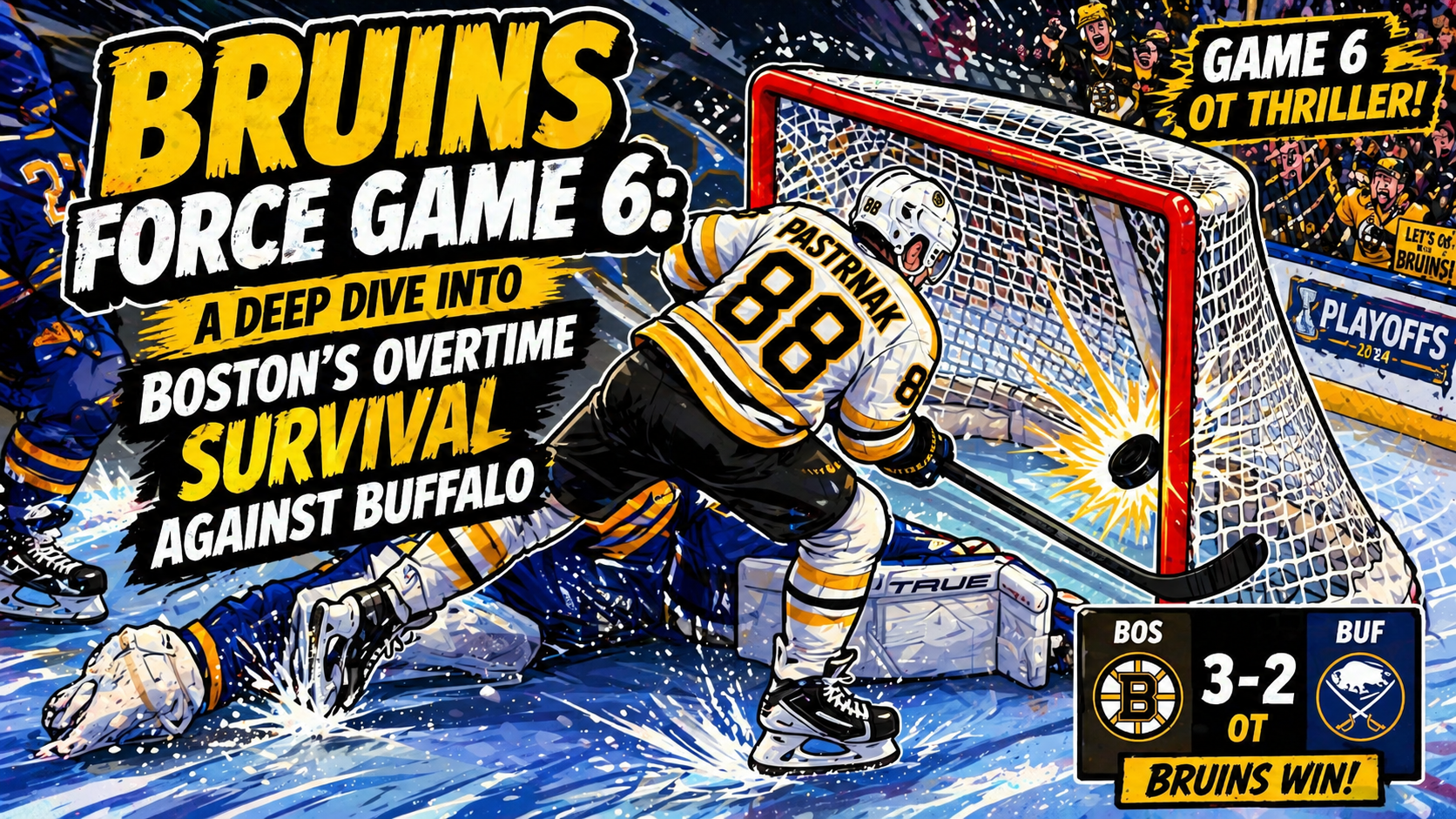
If hockey has taught us anything, it’s that stress is best measured not in heartbeats per minute but in the number of nachos spilled when your team almost gives up a playoff goal. On April 28, 2026, the Boston Bruins decided to test the cardiovascular health of New England by dragging Game 5 into sudden death before sealing a 2-1 overtime victory against the Buffalo Sabres. David Pastrnak, whose stick often seems to operate under the laws of cinematic timing, delivered the winning goal at 9:14 of overtime, keeping the Bruins’ playoff hopes alive. For the devoted fans at TD Garden—or huddled in living rooms hoping their pets survive another third-period nail-biter—this was not just a hockey game. It was a slow-burn thriller punctuated by the occasional primal scream.
Let’s not understate the situation: the Bruins entered Game 5 staring down elimination, trailing 3-1 in the first-round series. An early Buffalo power-play goal by Rasmus Dahlin in the first period felt like the universe nudging Boston toward summer tee times and fishing trips. But Jeremy Swayman, the calm eye in Boston’s storm, turned aside 24 of 25 shots, including a critical overtime save that directly led to Pastrnak’s breakaway heroics. In the second period, Elias Lindholm struck back unassisted, a scrappy equalizer that reminded us that playoff hockey is as much about grit as grace.
The Anatomy of an Overtime Victory
Overtime playoff hockey is a unique psychological experience. It’s part fear, part adrenaline, and part sheer disbelief that one tiny piece of rubber can dictate the mood of an entire region. The Bruins approached OT like a team on the edge of an abyss—methodical, patient, and looking for that single defensive lapse to exploit. It came when Buffalo’s defenders pinched a bit too aggressively, allowing Pastrnak to streak into open ice. The puck met his blade, the net met the puck, and TD Garden met a decibel level usually reserved for rocket launches.
Swayman’s contribution cannot be overstated. Playoff goaltending is a lonely occupation: your name is either etched in glory or muttered in frustration across a thousand living rooms. His 24 saves weren’t just numbers on a scoresheet; they were narrative pivots. That glove save in overtime? It was the difference between a somber handshake line in Buffalo and a chance to drag this series back to Boston for Game 6.
Buffalo’s Perspective: Close, But Not Closed
The Buffalo Sabres, a team that has been both rejuvenated and vilified in equal measure this season, found themselves a single bounce away from their first playoff series victory in over a decade. Alex Lyon, their goaltender of the moment, stopped 27 shots and held firm until the cruel arithmetic of hockey luck intervened. The Sabres’ offensive rhythm, led by Dahlin’s power-play goal, sputtered as Boston tightened the neutral zone. Their inability to capitalize on late third-period chances will haunt them if the series extends to a nerve-wracking Game 7.
The Psychology of Hockey Survival
Playoff hockey survival is not just about winning; it’s about rediscovering belief. Teams facing elimination often talk about “one shift at a time,” which is a polite way of saying, “We are desperately trying to compartmentalize our existential dread.” The Bruins’ Game 5 performance exemplified this mindset. They didn’t dominate offensively—Buffalo held long stretches of possession—but they did the little things that extend seasons: blocking shots, winning board battles, and getting sticks in passing lanes.
There is also a comedic element to this kind of survival. Watch the bench during overtime and you’ll see a collection of elite athletes suddenly transformed into anxious spectators, vibrating with every deflection. Head coach Jim Montgomery looked like a man who had just remembered he left his oven on at home but couldn’t leave the building to check.
Keys to Game 6
Looking ahead to Game 6, the Bruins must address several tactical and emotional factors if they intend to push this series to a decisive Game 7.
- Capitalize on Momentum: Emotional victories can fuel performance, but only if harnessed into disciplined play. Boston must ride the OT win without succumbing to overconfidence.
- Defensive Consistency: Limiting Buffalo’s zone entries and controlling the blue line will be crucial, especially against Dahlin’s puck-moving ability.
- Special Teams: The Bruins’ penalty kill held up in Game 5, but gifting the Sabres power plays is tempting fate.
- Goaltending: Swayman has become Boston’s playoff metronome. Another performance like Game 5’s will be mandatory.
Humor in the High-Stakes Chaos
For all the tension, playoff hockey has a way of sneaking in absurdity. In Game 5, the Sabres’ fans famously sang “O Canada” when the anthem singer’s microphone failed, a moment equal parts endearing and meme-worthy. Hockey, in its core, thrives on these quirks: the bouncing pucks, the spontaneous crowd serenades, and the general sense that sanity is optional once the postseason begins.
This series has also introduced the recurring drama of Viktor Arvidsson’s absence, as he remains out with an upper-body injury. Bruins fans have developed a strange superstition around his return, speculating that he might descend from the rafters like a masked luchador to score a critical goal at any moment. Of course, real life is less theatrical, but the imagination of a playoff crowd knows no bounds.
Conclusion: The Edge of the Knife
Game 5 was more than survival; it was a declaration that the Boston Bruins are not ready to pack up their gear and fade into summer. Whether it’s Pastrnak’s flair for the dramatic or Swayman’s quiet brilliance, this series now tilts back toward Boston with a renewed sense of possibility. Game 6 will test every ounce of their resolve, and if they succeed, the hockey world may be treated to the sweetest of sports narratives: a Game 7 under the bright lights. Until then, fans will live in that space between dread and euphoria that only playoff hockey can provide.
| As of April 30, 2026, the Boston Bruins are in the first round of the Stanley Cup Playoffs against the Buffalo Sabres. The next game is scheduled for Friday, May 1, 2026, at 7:30 PM ET at TD Garden in Boston. Broadcast details are yet to be announced. For the most current information, please refer to the official Boston Bruins website or trusted sports news outlets. |
Leave a Reply
You must be logged in to post a comment.