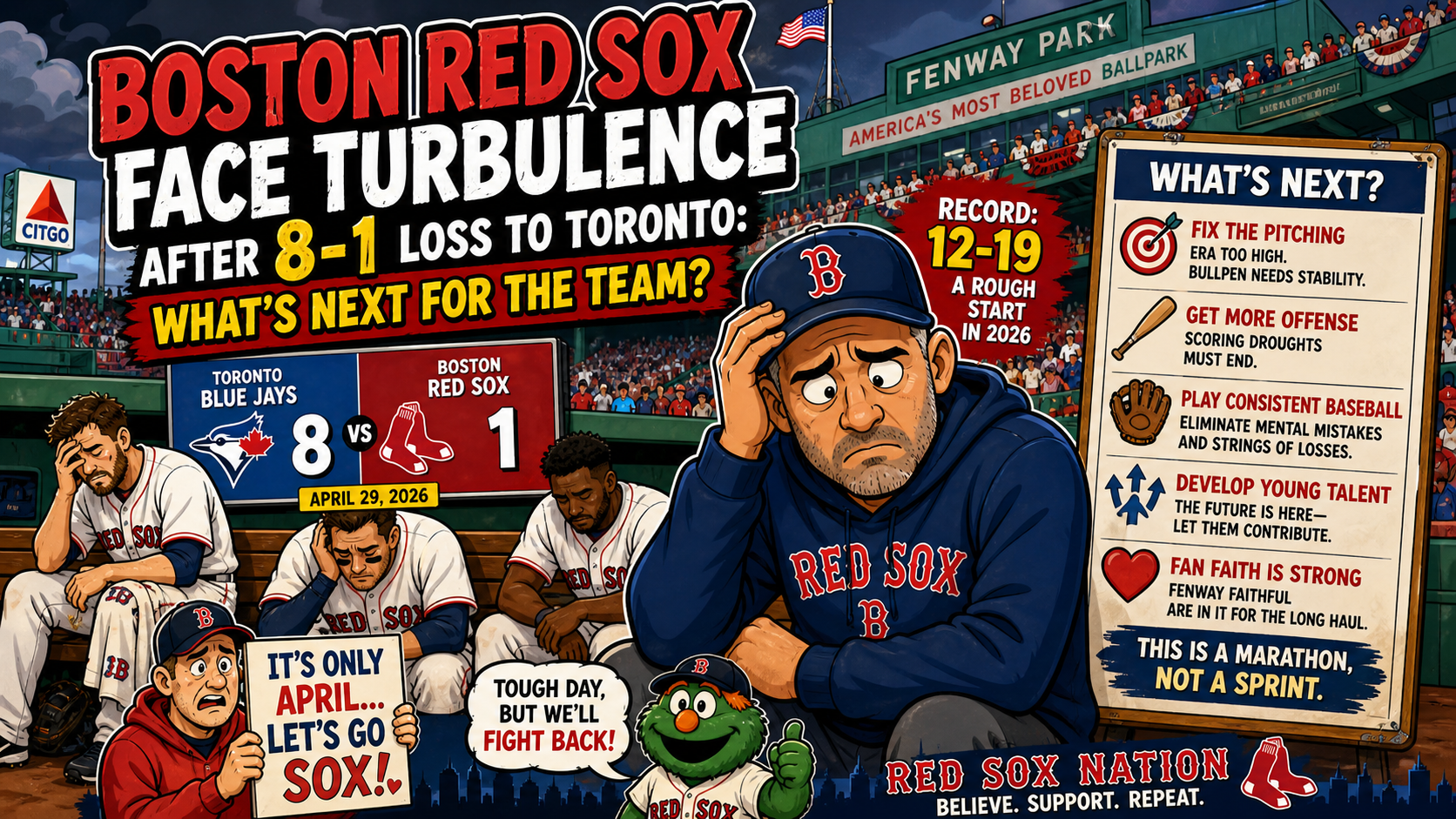
The Boston Red Sox are currently navigating the kind of early-season turbulence that makes even the most loyal Fenway faithful question whether they should invest in antacids in bulk or just start meditating. After their 8-1 loss to the Toronto Blue Jays on April 29, 2026, the team finds itself at 12-19, a record that feels like a polite way of saying “please fasten your seatbelts, we are experiencing baseball-related turbulence.” It’s the sort of start that reminds you that the marathon of Major League Baseball is not for the faint of heart—or for those who enjoy sleeping without worrying about bullpen meltdowns.
Brayan Bello took the mound in Toronto hoping to stabilize a rotation already coughing like a jalopy in February, but instead, he delivered 3.2 innings of four-run baseball. In relief, Greg Weissert surrendered a two-run blast to Ernie Clement, because apparently Clement woke up that morning and chose chaos. The lone offensive spark for Boston came from Willson Contreras, who launched a solo home run, reminding fans that homers are indeed possible, even if the scoreboard suggests otherwise. And just to add a dollop of existential dread, Garrett Crochet—Boston’s ace and one of the few pitchers in the rotation who can make hitters look like they are swinging underwater—was placed on the 15-day injured list with left shoulder inflammation. Nate Eaton has been called up from Triple-A Worcester to fill the roster spot, which is a little like swapping out a Maserati for a sturdy bicycle when you really needed a bus.
Analyzing the Red Sox’s Early Struggles
At 12-19, the Red Sox are finding themselves in the kind of predicament that forces deep introspection. This early-season record doesn’t necessarily doom a team—after all, we’ve seen miraculous turnarounds before—but the underlying numbers raise a few eyebrows. The pitching staff, for one, has been a source of heartburn. Even before Crochet’s injury, the team’s ERA was hovering in the bottom third of the league, which is not exactly the neighborhood you want to live in if your dream is to play meaningful games in October. Brayan Bello’s inconsistency, combined with the bullpen’s habit of treating late innings like a live reenactment of a disaster film, has left the team scrambling.
The offense hasn’t fared much better. While the Red Sox have shown occasional flashes of competence—like Willson Contreras’s recent homer—they’ve struggled to string together hits or capitalize with runners in scoring position. It’s as if the lineup collectively decided to play an elaborate game of “who can leave the most men on base,” and unfortunately, they’re winning at that game. In the modern game, with offenses leaning heavily on the long ball, the inability to generate consistent rallies becomes glaring.
The Garrett Crochet Factor
The placement of Garrett Crochet on the 15-day injured list cannot be understated in its significance. Crochet has been the kind of pitcher fans buy tickets to specifically watch, possessing both the velocity and movement that make batters reconsider their career choices. Losing him for any period is a gut punch, and for a team already struggling, it’s akin to misplacing the one oar you had while navigating a rapidly moving river. The Red Sox will have to rely on a mix of young arms and hopefully-not-overworked relievers to carry the load. Nate Eaton’s call-up is more about depth than dominance, and while Eaton has shown promise in Triple-A, expecting him to immediately stabilize the rotation is optimistic at best, delusional at worst.
What Needs to Change?
First and foremost, the Red Sox need their starting rotation to give them a fighting chance. In baseball, the greatest equalizer is consistent pitching, and right now, Boston’s starters are putting the bullpen in high-stress situations far too often. If Bello can find his rhythm, and if the team can get competent outings from the middle of the rotation, it will at least give the offense a chance to rediscover itself. The bullpen, while serviceable in bursts, can’t shoulder the load of three-to-four innings every night without eventually combusting like an overused microwave.
Offensively, Boston must rediscover situational hitting. Analytics have their place, but even the most data-driven front office can’t ignore the reality that scoring requires runners to cross the plate, not just amass on the bases like tourists waiting for a trolley. Managerial strategies may need to evolve, leaning on small ball and aggressive baserunning in games where the slugging simply isn’t there. In other words: sometimes you bunt, even if Twitter doesn’t approve.
Why the Upcoming Homestand and Road Trip Matter
The Red Sox return to Fenway Park to face the Houston Astros starting May 1, a series that feels like a quiet referendum on whether this team can hang with legitimate contenders. The Astros are perennial World Series threats and traditionally treat opposing pitchers like warm-up exercises, so Boston’s arms will be tested immediately. After that, the team heads to Detroit for a three-game set against the Tigers—a series that offers a chance to regain confidence if the Red Sox can avoid self-sabotage. The week concludes back at Fenway against the Tampa Bay Rays, another divisional opponent that can turn minor mistakes into major deficits faster than you can say “shift ban.”
This stretch is critical not just for the standings, but for the team’s psyche. Baseball, for all its statistics, is a mental grind. A week of competitive play could steady the ship. A week of continued collapse might lead to some difficult decisions in the front office, especially if the fan base starts making papier-mâché effigies of the pitching staff.
Here is the Boston Red Sox schedule for the next seven days, starting from May 1, 2026, including game details and broadcast information. Please note that all games are regular-season matchups, and no exhibition or World Baseball Classic training games are scheduled during this period.
| Date | Home | Visitor | Time (ET) | Location | Broadcast Network |
|---|---|---|---|---|---|
| May 1, 2026 | Boston Red Sox | Houston Astros | 7:10 PM | Fenway Park | NESN, WEEI-FM (93.7) |
| May 2, 2026 | Boston Red Sox | Houston Astros | 4:10 PM | Fenway Park | NESN, WEEI-FM (93.7) |
| May 3, 2026 | Boston Red Sox | Houston Astros | 1:35 PM | Fenway Park | NESN, WEEI-FM (93.7) |
| May 4, 2026 | Detroit Tigers | Boston Red Sox | 6:40 PM | Comerica Park | NESN, WEEI-FM (93.7) |
| May 5, 2026 | Detroit Tigers | Boston Red Sox | 6:40 PM | Comerica Park | NESN, WEEI-FM (93.7) |
| May 6, 2026 | Detroit Tigers | Boston Red Sox | 6:40 PM | Comerica Park | NESN, WEEI-FM (93.7) |
| May 7, 2026 | Boston Red Sox | Tampa Bay Rays | 7:00 PM | Fenway Park | ESPN, WEEI-FM (93.7) |
In conclusion, the Red Sox are in a precarious spot but far from doomed. Baseball seasons are long, and fortunes can change quickly. For now, fans can cling to the hope that the upcoming games will ignite a turnaround—or at the very least, provide entertaining chaos worthy of a Fenway summer.
Leave a Reply
You must be logged in to post a comment.