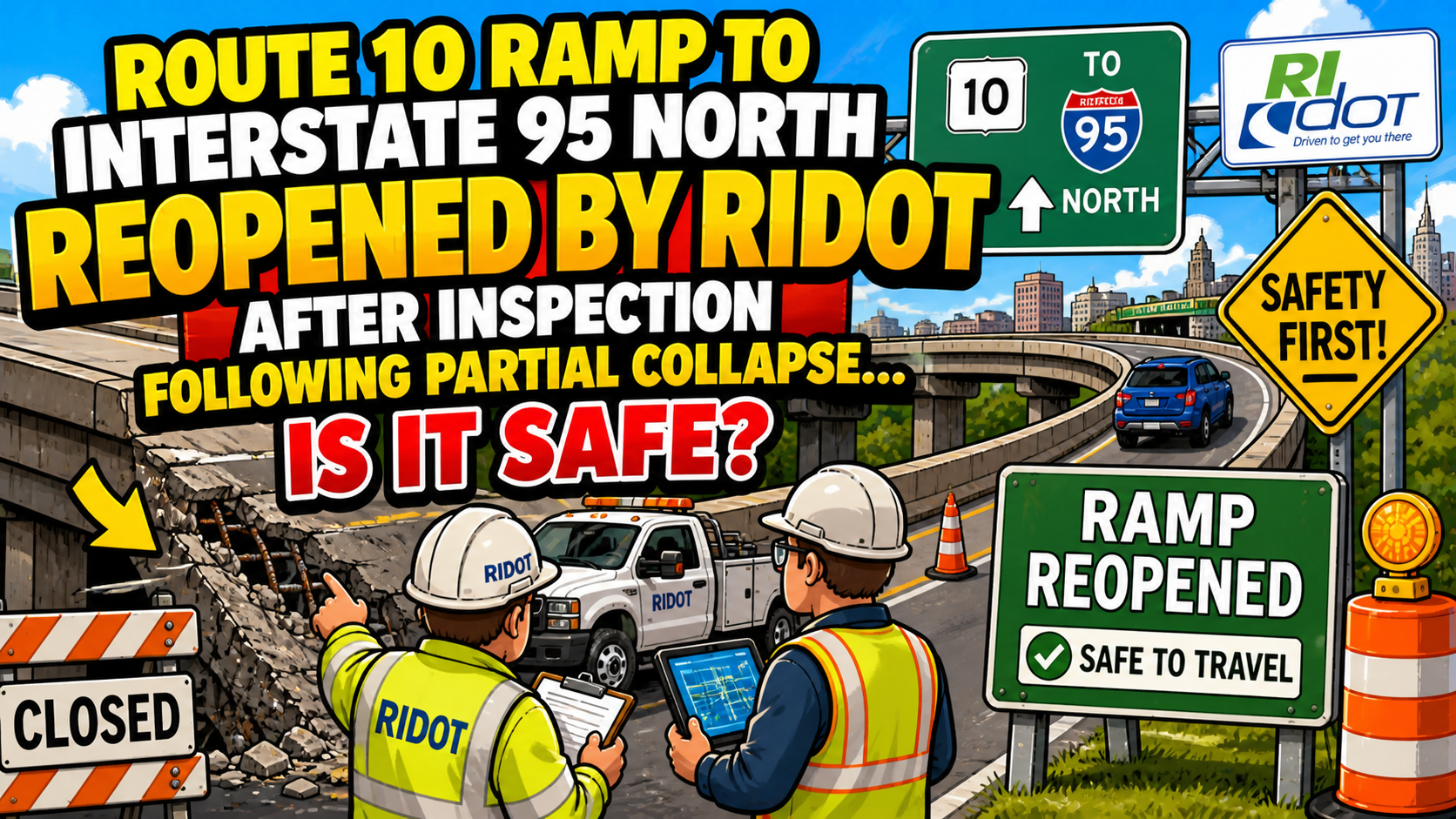
The Route 10 ramp reopened to I-95 North in Cranston after RIDOT completed emergency repairs and inspections following a barrier and parapet collapse that sent debris onto the train tracks below.
On a busy weekday morning in Providence, Rhode Island, drivers were met with unexpected news: the Route 10 ramp connecting to Interstate 95 North had been reopened by the Rhode Island Department of Transportation (RIDOT) after a thorough inspection. This reopening came only days after a partial barrier/parapet collapse that raised alarms across the state and prompted immediate closures. While the restoration of traffic flow is a relief to thousands of commuters, the question lingers—how safe is this ramp, and what does its reopening reveal about the condition of Rhode Island’s infrastructure?
According to RIDOT’s Route 10 North to I-95 North ramp closure update, the ramp was temporarily closed after an Amtrak electrical shield and parapet fell onto the train tracks below the structure on April 24.
What Happened Before the Route 10 Ramp Reopened?
The partial collapse of the Route 10 ramp was not a complete structural failure but rather a localized compromise in one of the concrete support sections. Witnesses reported visible crumbling along the edge of the ramp, and RIDOT quickly implemented a closure to prevent any potential accidents. The closure caused significant traffic delays, with detours funneling vehicles through alternate routes in Providence’s already congested downtown corridor.
Immediately after the incident, RIDOT mobilized its engineering teams and contracted structural specialists to conduct an emergency assessment. Utilizing ground-penetrating radar, visual inspections, and load testing, the agencies sought to determine the immediate risk to the traveling public. According to RIDOT’s official statement, the inspection concluded that the remainder of the ramp maintained its structural integrity. After short-term repairs and the installation of temporary reinforcements, the ramp was deemed safe for reopening.
Route 10 Ramp Safety Concerns for Rhode Island Drivers
Reopening a ramp after a partial collapse naturally invites public skepticism. Drivers who commute daily along I-95, one of the busiest transportation corridors in the Northeast, must now contend with a lingering sense of unease. While RIDOT has assured the public that the ramp is safe, many Rhode Islanders recall previous high-profile infrastructure failures across the country, such as the I-35W bridge collapse in Minneapolis, and are left questioning whether temporary repairs can truly guarantee safety.
Officials have emphasized that the ramp will be subject to ongoing monitoring, including daily visual checks and more comprehensive structural reviews in the coming months. Still, confidence is not built overnight. Infrastructure trust relies not only on engineering assessments but also on a transparent commitment to long-term investment in public safety.
The fact that the Route 10 ramp reopened so quickly may ease traffic congestion, but it also raises fair questions about how emergency repairs are evaluated and communicated to the public.
Rhode Island’s Aging Infrastructure Problem
Rhode Island has long faced challenges with aging roadways and bridges. Reports from the American Society of Civil Engineers (ASCE) have consistently rated the state’s infrastructure among the most in need of attention in the nation. Many of the bridges and ramps in the Providence area were constructed in the mid-20th century and have been subjected to decades of freeze-thaw cycles, heavy traffic loads, and deferred maintenance. This combination has left multiple structures vulnerable to incidents like the one on Route 10.
The partial collapse, though contained, serves as a stark reminder of the cumulative effects of deferred maintenance. Even if RIDOT’s emergency inspections declare the ramp safe, the underlying issue remains: many of Rhode Island’s bridges are functionally obsolete or approaching the end of their intended service life. Waiting for visible failures before initiating repairs is a reactive model that can only be sustained for so long.
Engineering Assessments and Risk Evaluation
From a technical standpoint, evaluating the safety of a ramp or bridge involves a combination of structural analysis and probabilistic risk assessment. When RIDOT inspected the Route 10 ramp, the goal was not simply to determine whether it could stand today, but whether it could safely withstand the dynamic loads of thousands of vehicles each day until more permanent repairs are completed.
According to transportation engineers, such inspections examine elements including:
- Concrete integrity and the presence of surface or subsurface cracks
- Corrosion of reinforcing steel and bearings
- Load distribution and redundancy in the structure
- Drainage efficiency and water infiltration patterns
By addressing these factors, engineers aim to classify the remaining risk. A ramp can be considered safe in the short term if its structural elements demonstrate adequate load-bearing capacity, even if long-term durability remains in question. In the case of the Route 10 ramp, the decision to reopen likely relied on the conclusion that the compromised section was isolated and that temporary reinforcement would prevent further deterioration or sudden failure.
Community and Commuter Reactions
Public response to the reopening has been mixed. Many commuters expressed relief that traffic congestion caused by the closure would ease, particularly during peak travel hours. Others voiced frustration and concern on social media, questioning whether the state prioritized mobility over safety. The incident has also sparked political discussion around infrastructure spending, with local leaders calling for a renewed focus on preventative maintenance and federal funding support.
For residents of Providence’s nearby neighborhoods, the closure and rapid reopening served as a reminder of how deeply intertwined infrastructure is with daily life. Detours pushed traffic onto local streets, increasing noise and air pollution, while also slowing emergency response times in some areas. The safe and reliable operation of major interchanges like Route 10 and I-95 is not just a matter of convenience—it is a fundamental component of public safety and economic vitality.
Long-Term Solutions and Policy Considerations
In the aftermath of the partial collapse, policymakers and engineers alike have emphasized the need for sustainable long-term solutions. Rhode Island’s infrastructure challenges are part of a broader national issue in which aging bridges and highways require more investment than current budgets typically allow. Federal infrastructure packages have offered some relief, but the cycle of reactive maintenance has proven difficult to escape.
Experts recommend a multi-pronged approach to prevent future incidents:
- Comprehensive structural audits of all aging ramps and bridges
- Prioritization of funding for high-risk structures rather than cosmetic improvements
- Implementation of predictive maintenance using sensors and AI-driven monitoring
- Increased public transparency on inspection results and repair timelines
Incorporating these measures could reduce the risk of sudden closures and restore public confidence in the safety of the state’s roads. Rhode Island’s small geographic size may actually work in its favor, allowing for more targeted investments if the political will and funding streams align.
Is the Route 10 Ramp Safe Now?
Based on the available information, the Route 10 ramp is considered safe for daily use under current conditions. Engineering inspections and emergency reinforcements have addressed the immediate risks. However, safety in this context is a relative concept, contingent on ongoing monitoring and timely long-term repairs. The ramp’s history, combined with the broader state of Rhode Island’s infrastructure, suggests that vigilance must remain high.
In short, drivers can use the ramp with confidence in the near term, but the incident should serve as a wake-up call. The health of the transportation network is only as strong as its weakest link, and proactive management of aging structures is critical to ensuring that incidents like this remain rare and non-catastrophic.
Conclusion
The reopening of the Route 10 ramp to Interstate 95 North is a relief for commuters and a testament to swift engineering response. Yet the episode underscores the fragility of Rhode Island’s aging infrastructure and the importance of sustained investment in safety. While the ramp is safe today, true security lies in proactive maintenance, transparent oversight, and the long-term rehabilitation of the state’s transportation network.
Leave a Reply
You must be logged in to post a comment.