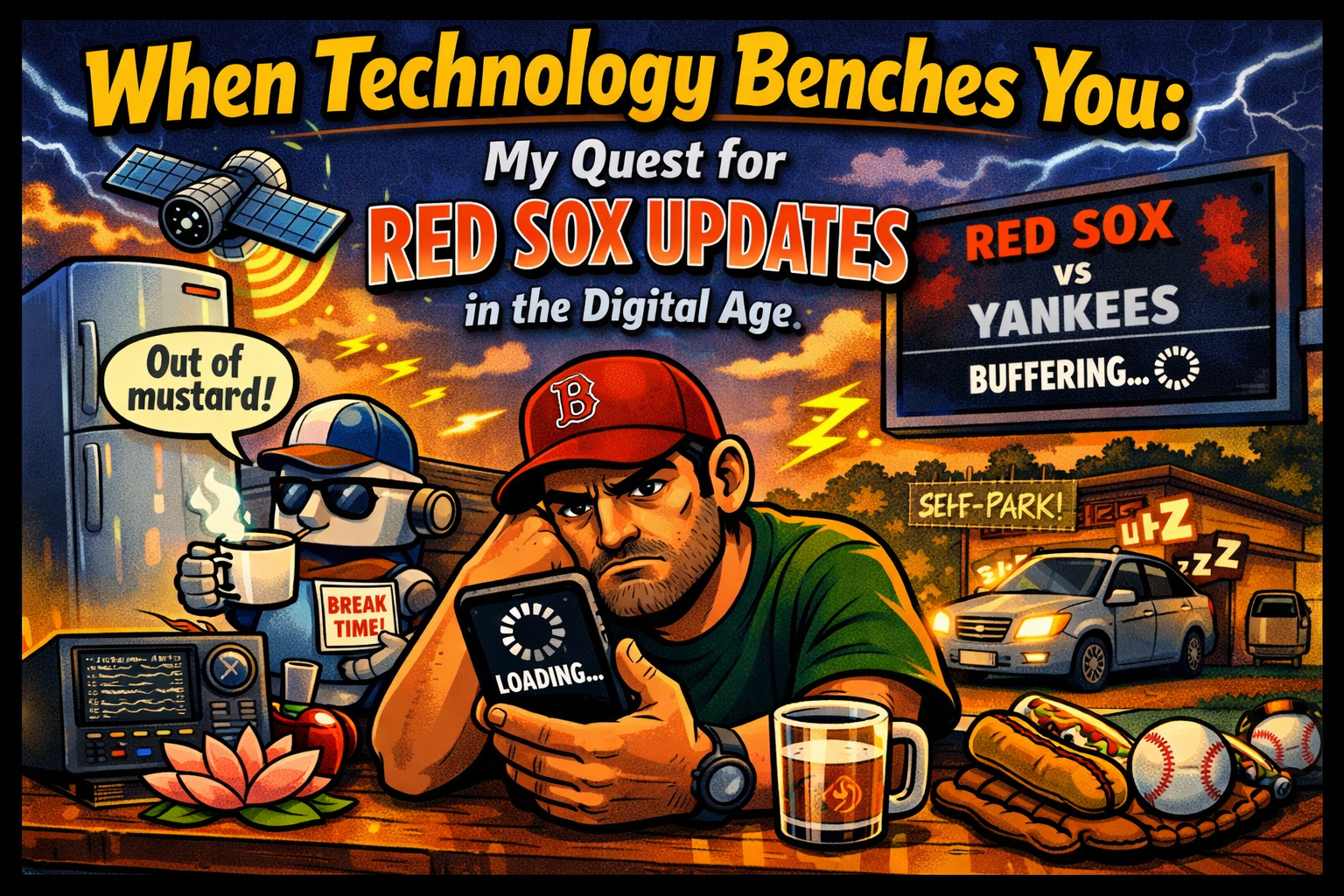
It seems almost unthinkable in 2026: a world where practically every pocket holds a device capable of communicating with satellites, accessing global databases, and ordering a cheeseburger to your exact GPS coordinates. And yet, there I was, staring at a spinning wheel of doom on my phone, desperately trying to check the Boston Red Sox score. The digital rug had been pulled out from beneath me, and I was left stranded in the uncanny valley of modern fandom.
Now, please understand: I am not unaware of the irony. We live in an era where A.I. can write research papers, cars can parallel park themselves, and a refrigerator will text you if you’re out of mustard. But for some inexplicable reason, when I needed to see how the Sox were doing against the Yankees, my devices decided to take a coffee break. It was as if the universe collectively said, “Nah, let’s see how resourceful you really are.”
The Digital Delusion of Sports Fans
Sports fandom in the modern age has become a strange fusion of ritual and algorithm. Once upon a time, people simply went to Fenway Park, listened to the radio, and read the sports section the next morning. These days, the average fan has multiple score widgets, social media feeds, and push notifications configured to deliver stats faster than a closer’s fastball. The expectation is instantaneous enlightenment: pitch-by-pitch updates, heat maps, and exit velocities cascading across multiple screens.
But this expectation is also a trap. I didn’t realize how addicted I was until everything failed at once. My phone gave me the dreaded “Cannot Refresh,” my tablet decided it needed a system update at that exact moment, and my smart speaker sat silently, awaiting a Wi-Fi signal like a scolded puppy. Even my television betrayed me, demanding a streaming login I couldn’t remember. Suddenly, I was plunged into the quiet, cruel void of pre-internet sports fandom, with only my imagination and a dusty AM radio to guide me.
When Apps Go on Strike
Attempting to get information about the Red Sox in this moment became a farcical odyssey. I first tried the MLB app, only to be met with a loading screen that stared back at me like an accusatory umpire. Then, I pivoted to ESPN’s page, which apparently decided that my interest in baseball was secondary to a sponsored video about professional cornhole highlights. By the time I found the tiny “Red Sox” link, the site froze as if it, too, was suffering from stage fright.
Undeterred, I turned to social media. Twitter—or X, or whatever branding experiment we’re pretending to like this month—was flooded with memes, conspiracy theories, and a single post announcing that someone’s cat had accidentally walked across their keyboard. There was no box score, no highlight reel, just a wasteland of distraction.
The Art of Analog Survival
In this moment of crisis, I realized that true fandom requires preparation. What if the Red Sox were in the middle of a perfect game and I had no idea? What if a rookie hit for the cycle, and the only thing I could tell my grandchildren was that I was busy cursing at a router?
So I did the unthinkable: I dug out an actual radio. It clicked, it hummed, and then it delivered the sweet, slightly crackling voice of a play-by-play announcer describing a 3-2 count with runners on the corners. It was a revelation. I didn’t need 4K replays or Statcast graphics to savor the drama. I just needed sound and imagination. In fact, without the visual overload, I found myself more invested in each pitch, leaning in as if my auditory focus could help the Sox score a run.
Lessons from a Digital Blackout
This experience reminded me of something essential: technology is a luxury, not a guarantee. Sports are meant to be felt, not merely consumed. There is an intimacy in following the cadence of a radio announcer or refreshing a printed scoreboard in your mind. It revives the patience and imagination that constant streaming has slowly eroded.
- Always have a backup method for game updates—radio, TV, or even a friend on speed dial.
- Embrace the suspense that comes with not knowing the score for a few minutes.
- Remember that fandom is about the journey, not just the instant gratification of stats.
So, if you ever find yourself unable to access Red Sox news in the digital era, take a deep breath. Consider this your invitation to reconnect with the analog roots of sports culture. Listen to the rhythm of the game, not just the data points. And if all else fails, there’s a kind of comedic relief in realizing that sometimes, the most advanced technology in the world can’t do what a $10 radio can.
How to Stay Informed Even When the Internet Won’t Cooperate
When your devices betray you, here’s a simple playbook for surviving the blackout:
- Keep the MLB app updated, and make sure you know the offline features—it occasionally caches the last scores.
- Bookmark radio stations that stream games, and consider an old-school portable radio for emergencies.
- Create a group chat with fellow fans who can relay updates if your feed goes down.
And yes, if all else fails, you can simply wait for the highlights the next morning. There’s a weird, almost meditative patience that comes with letting go of the need to know immediately. It also makes the eventual score reveal feel like opening a letter from an old friend.
It looks like I’m having trouble pulling the latest Red Sox results and news online right now. Here’s how you can still get the info quickly: Check the MLB app or MLB.com for the April 27, 2026, box score and highlights. Visit ESPN’s Red Sox page for recent news and recaps. If you’d like, I can summarize yesterday’s game and key stories as soon as I successfully fetch the data again. Would you like me to try again in a moment?
In conclusion, a brief technological hiccup taught me more about baseball than a thousand push notifications ever could: the game is best enjoyed with attention, patience, and a sense of humor. Whether you’re at Fenway or fumbling through apps, the joy of being a Red Sox fan doesn’t need perfect Wi-Fi—it just needs you.
Leave a Reply
You must be logged in to post a comment.