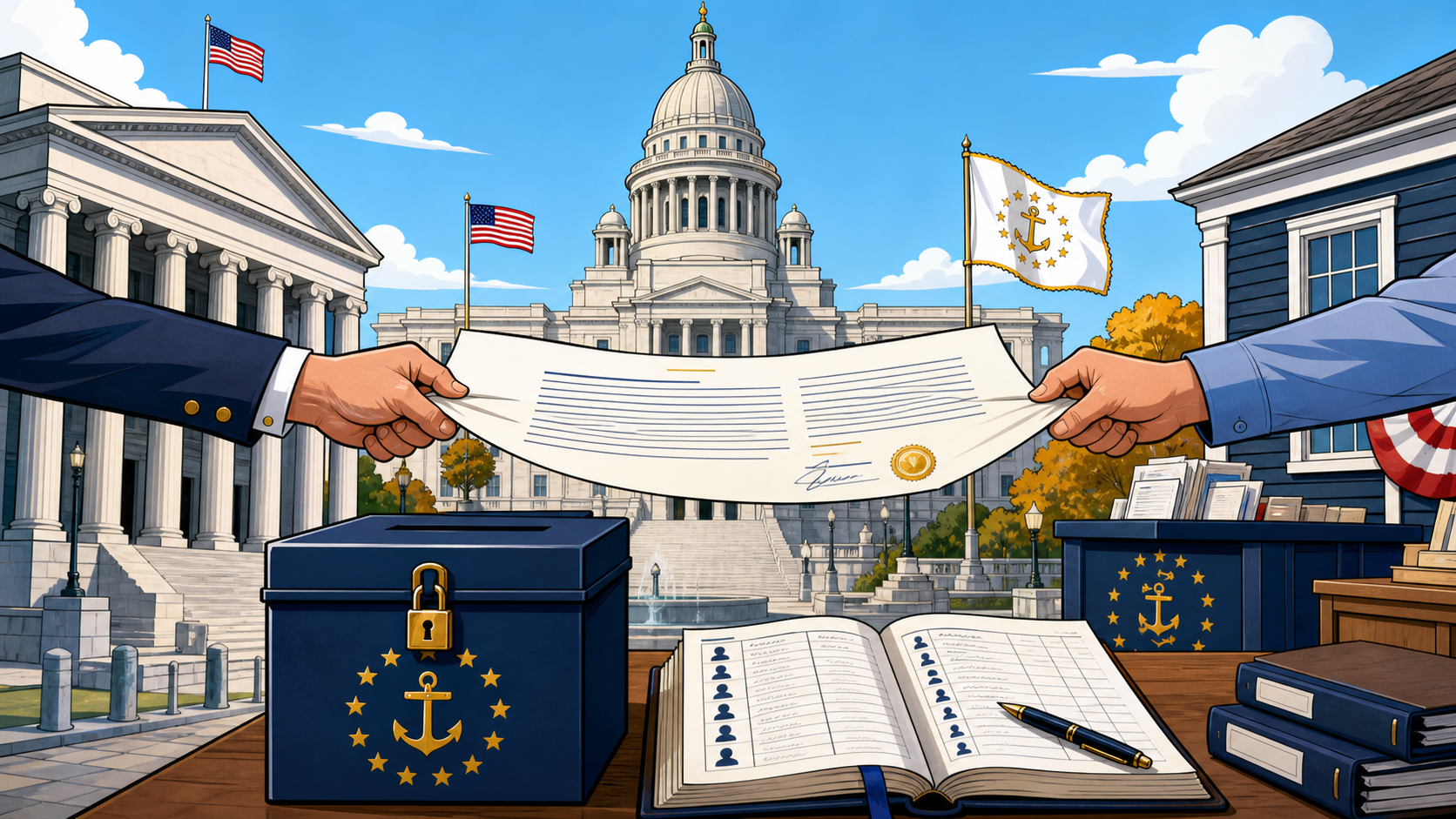
The Justice Department says it is reminding states to keep noncitizens from voting. Rhode Island Secretary of State Gregg Amore says the message is really an attempt to intimidate election officials. Here is what happened, what the law already requires, and why this fight matters before the 2026 election.
Updated July 13, 2026.
Rhode Island politics can turn a pothole into a three-act drama, so a fight involving Washington, voter rolls, private data, and possible criminal charges was never going to pass quietly.
On July 7, the U.S. Department of Justice sent Rhode Island Secretary of State Gregg Amore a letter warning that election officials could face criminal liability if they knowingly keep noncitizens on voter rolls or help them cast ballots. The letter asked Rhode Island to explain within five days how it maintains accurate voter lists and complies with federal law.
Amore’s response was blunt: Rhode Island already follows the law, and he considers the letter an intimidation tactic rather than a sincere offer of help.
That leaves Rhode Islanders with a fair question: Is this a needed election-security reminder, or is the federal government using the threat of prosecution to pressure state officials after losing an earlier voter-data case?
The quick answer
- Noncitizens are not permitted to vote in federal elections.
- Rhode Island requires voter-registration applicants to affirm their U.S. citizenship under penalty of perjury.
- The state uses mailings and data from agencies including the DMV, Department of Health, Department of Corrections, Social Security Administration, and Electronic Registration Information Center to maintain its voter list.
- A federal judge dismissed the Justice Department’s earlier lawsuit seeking Rhode Island’s unredacted voter file, which included sensitive identifying information.
- The federal government appealed that ruling in June.
- Nothing in this latest exchange changes how eligible Rhode Islanders register or cast a ballot today.
What the Justice Department sent Rhode Island
The July 7 letter came from Assistant U.S. Attorney General Harmeet K. Dhillon and was part of a nationwide message to state election officials.
According to the letter and current reporting, the Justice Department framed its message as assistance with federal election-law compliance. It also warned that an official who knowingly retains ineligible noncitizens on a statewide registration list or facilitates illegal voting could face criminal consequences.
That distinction matters. Enforcing the law against deliberate misconduct is one thing. Sending a broad warning to election administrators without publicly identifying a specific Rhode Island violation is another.
The federal position is straightforward: Only eligible citizens should vote in federal elections, states must maintain accurate voter lists, and officials who intentionally violate those rules can be prosecuted.
Few Rhode Islanders are going to argue with the first part. The controversy is about the federal government’s evidence, its tone, and how far it can reach into a state-run election system.
Why Gregg Amore calls the letter intimidation
Amore released the letter publicly on July 10 and said its purpose was to make election officials “fall in line” with what he described as federal overreach. His formal response said Rhode Island officials understand the applicable laws and remain committed to following them.
He also defended the state’s ongoing voter-list maintenance and invited anyone with actual evidence of fraud or an election-security problem to submit it for investigation.
That is the practical dividing line in this dispute:
| The Justice Department’s position | Rhode Island’s position |
|---|---|
| Federal law bars noncitizens from voting in federal elections. | Rhode Island agrees and says its current procedures comply with the law. |
| Election officials can face consequences for intentional violations. | A broad criminal warning without a specific state violation amounts to intimidation. |
| Federal oversight helps protect election integrity. | Federal demands must respect state authority, voter privacy, and the limits Congress placed in law. |
Both sides use the phrase “election integrity.” They disagree sharply about whether this letter protects it or damages public trust in it.
The voter-roll lawsuit behind the argument
This is not the first round between the Justice Department and Amore.
In September 2025, the department demanded an unredacted electronic copy of Rhode Island’s statewide voter-registration list. According to the federal court’s opinion, that file would have included the last four digits of voters’ Social Security numbers and Rhode Island driver’s-license numbers.
Amore offered the publicly available voter list but refused to provide the protected information. The Justice Department sued in December.
On April 17, 2026, U.S. District Judge Mary S. McElroy denied the department’s motion to compel production and dismissed the case. Her opinion found that the federal laws cited by the government did not authorize the demand as made. The court also noted that the demand did not identify facts suggesting Rhode Island had violated federal voter-list maintenance requirements.
The administration appealed on June 4. According to the latest reporting, the First Circuit has not yet heard the case, and an August 18 proceeding is expected to establish a briefing schedule.
One important bit of housekeeping: The July 7 warning letter is separate from the earlier lawsuit. The April ruling did not decide whether the new letter is legal. It did, however, create the political and legal backdrop that makes the new warning feel like much more than a routine compliance memo.
How Rhode Island says it maintains voter rolls
The debate can get loud, but the mechanics are fairly ordinary.
Rhode Island’s registration process requires applicants to affirm that they are U.S. citizens and Rhode Island residents and will be old enough to vote. False information can carry criminal penalties.
The state also updates and checks records through several channels:
- address information transmitted by the Rhode Island DMV;
- annual verification mailings and returned-mail procedures;
- death records from state vital-records officials and the Social Security Administration;
- Department of Corrections information involving felony incarceration;
- interstate data comparisons through the Electronic Registration Information Center;
- local boards of canvassers that process voter updates and removals under state and federal rules.
In November 2025, Rhode Island sent a voter-list maintenance letter to registered voters statewide. The Department of State says the second stage of that process began in February 2026.
This does not mean every entry is instantly perfect. People move, die, change names, and sometimes fail to update records. Federal law also limits how and when officials may remove registrations, so an old or inactive record is not automatically proof that an illegal ballot was cast.
What Rhode Island voters should do
This argument is being fought by lawyers and elected officials, but regular voters have a short checklist:
- Check your registration. Confirm that your name, address, and party affiliation are correct through Rhode Island’s official voter portal.
- Respond to official election mail. If the Department of State asks you to confirm or update information, follow the instructions promptly.
- Return mail for former residents. Mark it “Not at this address” and return it so officials can begin the legally required update process.
- Bring evidence, not internet fog. Report a specific election concern to the Department of State or your local board of canvassers. A viral post is not an investigation.
- Do not assume your eligibility changed. Nothing announced in this dispute creates a new registration or voting requirement for eligible Rhode Islanders.
My take: enforce the law, but show your work
Noncitizen voting in federal elections is illegal. If an election official knowingly helps it happen, that deserves a real investigation and real consequences. That should not be a partisan statement.
But the Justice Department should also have to show its work.
If federal officials have evidence of a Rhode Island problem, they should present it through lawful channels. If they do not, warning state and local workers about criminal prosecution—especially after a court rejected an earlier demand for sensitive voter data—looks more like political pressure than practical election security.
Amore and Rhode Island election officials do not get a free pass either. They should keep publishing clear information about list maintenance, removals, referrals, investigations, and verified cases. Public confidence is earned with evidence and transparency, not with “trust us” from either Providence or Washington.
The best outcome is not complicated: accurate voter rolls, protected personal data, eligible voters able to vote, ineligible ballots stopped, and politicians from both parties forced to support their claims with facts. Apparently, asking everyone to behave like adults is the controversial position now.
Frequently asked questions
Can noncitizens vote in Rhode Island’s federal elections?
No. Federal law prohibits noncitizen voting in federal elections, and Rhode Island voter-registration applicants must affirm that they are U.S. citizens under penalty of perjury.
Does the DOJ letter prove that noncitizens voted in Rhode Island?
No specific Rhode Island case was identified in the public reporting about the letter. The warning describes federal obligations and possible liability. Evidence of an actual illegal registration or ballot would still need to be investigated and proven.
Did a court already rule against the Justice Department?
Yes, but on the earlier demand for an unredacted statewide voter file. The federal district court dismissed that case and denied the request to compel production. The government has appealed. The court did not rule on the separate July 7 warning letter.
Can the federal government oversee state elections?
Congress may establish federal election rules, and the Justice Department may enforce federal statutes. States retain substantial authority over election administration. The current legal fight concerns where federal enforcement ends and state discretion and voter privacy begin.
Does this change what I need to vote in 2026?
No change has been announced because of this dispute. Eligible voters should use the official Rhode Island election website to confirm registration details, deadlines, and voting requirements.
Sources and further reading
- Secretary of State Gregg Amore’s July 10 statement
- Rhode Island Current report on the July 7 DOJ letter
- Federal court opinion in United States v. Amore
- Rhode Island Department of State voter-list maintenance information
- Justice Department’s December 2025 complaint
- Associated Press report on the April 2026 ruling
For another Ocean State policy dispute that affects residents directly, read Rhode Island’s 2026 EV Fees Ignite Debate Over Fairness and Climate Goals.
Leave a Reply
You must be logged in to post a comment.