Heads up: some links on this page are affiliate links. As an Amazon Associate I earn from qualifying purchases, at no extra cost to you.
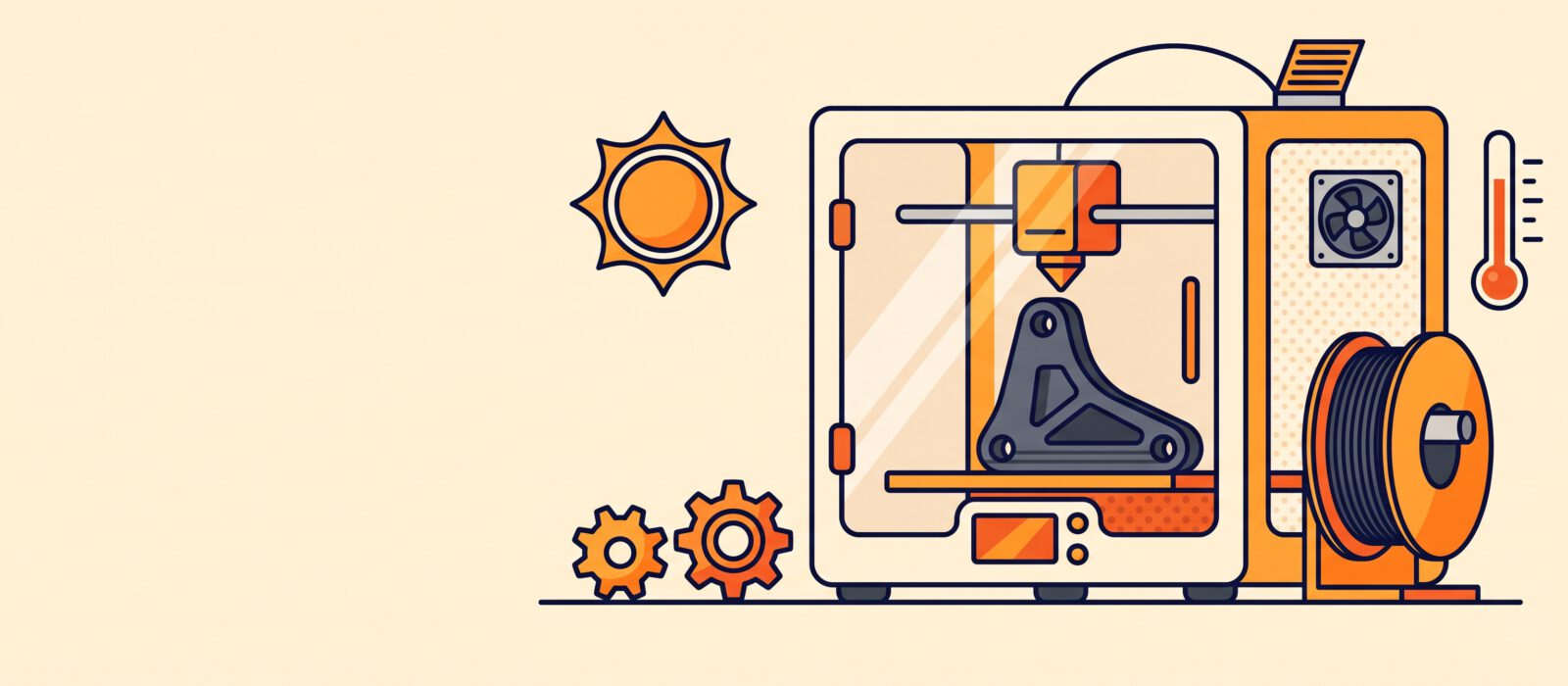
ABS and ASA are engineering plastics. They hold up under heat better than PLA or PETG and are used for car parts, enclosures and outdoor items. They also need more from you and your printer: an enclosure, steady temperatures and good ventilation. This guide explains whether they are worth it and how to print them safely.
ABS vs ASA at a glance
| Property | ABS | ASA |
|---|---|---|
| Nozzle temperature | 230 – 260 °C | 240 – 260 °C |
| Bed temperature | 90 – 110 °C | 90 – 110 °C |
| Enclosure | Required | Required |
| Cooling fan | Off or very low | Off or very low |
| Heat resistance | About 95 – 105 °C | About 95 – 105 °C |
| UV and weather resistance | Fair; can yellow in sun | Good |
| Warping | High | High |
| Acetone vapor smoothing | Yes | Generally no (check the maker) |
| Typical cost | $18 – $25 per kg | $22 – $32 per kg |
Heat, UV resistance and ease of printing (editorial rating out of 5)
What your printer needs
| Requirement | Why it matters | Options |
|---|---|---|
| Enclosure | Keeps air warm and still so layers bond and corners do not lift | Built-in (Bambu P2S, Elegoo Centauri Carbon, Kobra S1) or a tent for open printers |
| All-metal hotend | Safe at 250 °C and above | Standard on most modern printers; check yours |
| Heated bed to 100 °C | Holds the first layers flat | Most printers manage it; textured PEI or glass with adhesive helps |
| Ventilation or filter | Removes fumes | Window vent, ducted exhaust or a carbon-filtered enclosure |
Where to buy
| Item | Brands to look at | Where to buy |
|---|---|---|
| ABS filament | Hatchbox, Elegoo, Polymaker, SUNLU | Find on Amazon |
| ASA filament | Polymaker, Elegoo, SUNLU, Bambu Lab | Find on Amazon |
| Enclosure tent for open printers | Creality, Comgrow, generic | Find on Amazon |
| Dry box with silica gel | Any airtight box | Find on Amazon |
Settings that work
- Preheat the bed and let the chamber warm up for 10 – 15 minutes before starting.
- Turn the part cooling fan off or to 10 – 20 %.
- Use a brim or raft to hold corners down and avoid drafts.
- Print at moderate speeds and avoid large, flat, thin parts that warp.
- Use a clean textured PEI or glass with glue stick for adhesion.
Common ABS and ASA problems and fixes
| Symptom | Likely cause | Fix |
|---|---|---|
| Corners curl up | Chamber too cold or drafts | Preheat longer, close the enclosure, add a brim |
| Cracks between layers | Too much cooling | Fan off, raise temperature 5 – 10 °C |
| Strong smell | Normal for ABS | Increase ventilation; consider ASA or a low-odor blend |
| Print comes loose mid-print | Bed too cool | Raise bed to 100 – 110 °C, use adhesive |
| Thin parts look rough | Printing too fast | Slow down outer walls |
Not sure you need this? Our material comparison shows when PETG is enough. For an enclosed printer see our enclosed printers guide.
Frequently asked questions
Is ABS safer than PLA?
No. PLA has lower emissions and a milder smell. ABS and ASA need ventilation.
Can I print ABS in a cardboard box or tent?
A tent that holds heat can work, but keep it away from the heated bed and heating elements and never leave it running unattended. A purpose-built enclosure is safer.
Which should I buy, ABS or ASA?
ASA for outdoor parts or if ABS yellows. ABS if you plan to smooth with acetone vapor.
Do ABS and ASA need drying?
Yes, if they hiss or pop. Dry at about 80 °C for 4 hours, or follow the spool label.